

Why Cingal®
When knee osteoarthritis causes pain and stiffness, many people look for treatment that can help them move more comfortably, without surgery and without multiple injections.
Cingal is a treatment designed to reduce knee pain and improve movement. By combining two well-known injectable ingredients, a corticosteroid and hyaluronic acid, in one treatment, Cingal offers:
- Single injection
- Fast-acting pain relief
- Long-lasting symptom improvement
How Cingal Works
Cingal is injected directly into the knee joint by a doctor. It is different because it combines two ingredients in a single injection:
- A low-dose corticosteroid to quickly calm inflammation and reduce pain
- Hyaluronic acid (HA) to support movement and cushioning and give longer lasting pain relief
Each ingredient has a different role, and together they are designed to address knee pain in both the short and longer term.


Supporting the Knee to Move More Smoothly
Hyaluronic acid is found naturally in healthy knees. It acts like a lubricant and shock absorber, helping the joint move smoothly.
With osteoarthritis:
- Hyaluronic acid levels decrease
- Joint fluid becomes thinner
- Movement can feel stiff or painful
The hyaluronic acid in Cingal is designed to:
- Improve lubrication inside the knee
- Reduce friction between joint surfaces
- Support smoother movement
Hyaluronic acid injections have been used for many years to help manage knee pain caused by osteoarthritis, especially for people who want to delay or avoid surgery.
Helping Reduce Inflammation More Quickly
Inflammation plays a key role in osteoarthritis pain making symptoms feel more noticeable and harder to manage.
With osteoarthritis:
- The joint becomes inflamed
- Swelling can be present
- Movement is often more painful
Cingal contains a low dose of a corticosteroid, which is commonly used in joint injections to:
- Reduce inflammation and swelling inside the knee
- Help relieve pain more quickly
Corticosteroid injections are known for providing faster pain relief, although their effect alone is usually short-term.
Why combine both in one treatment?
By combining both ingredients in a single injection, Cingal aims to address inflammation-related pain and joint movement together, without the need for multiple injections.This approach is designed to address inflammation‑related pain and the stiffness and reduced movement that often come with it.
What the Studies Show
Clinical studies help doctors understand how treatments work in real people with knee osteoarthritis. Cingal has been studied for its effects on knee pain, movement and function, and how long relief may last.
Fast Acting
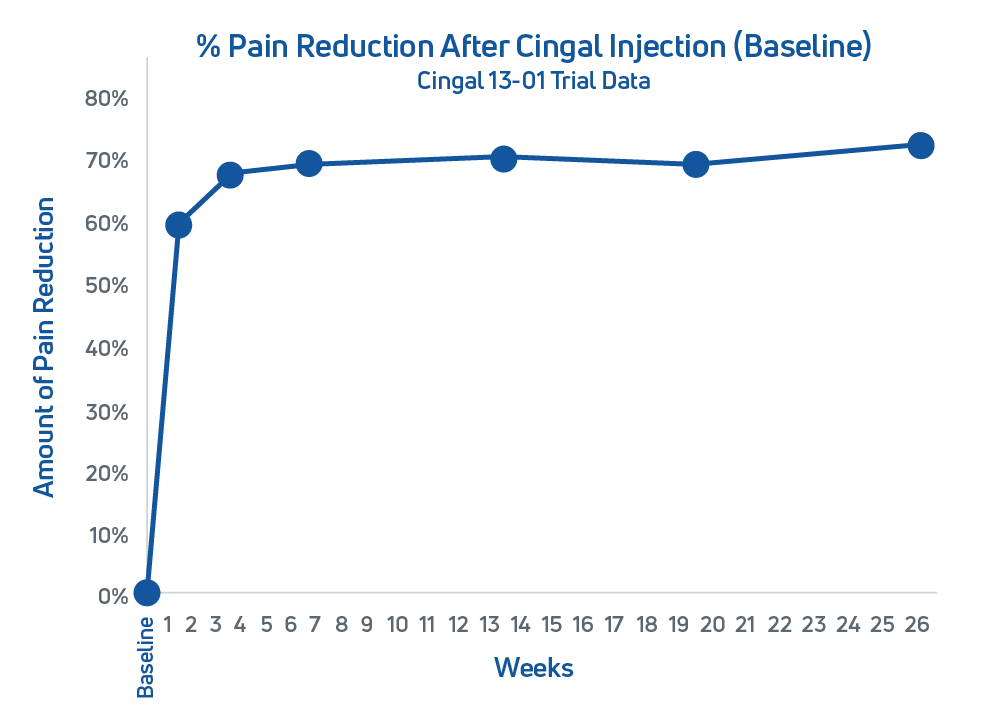
Patients experienced nearly 60% less pain within 1 week of their injection.1
Long Lasting
Patients experienced over 70% reduction in pain 6 months after their injection.1
Consistent
At 6 months, 9 out of 10 patients saw real improvement in pain and function.1
1. 13-01 Data on file
Pain Relief and Function
In clinical studies, people treated with Cingal experienced reduced knee pain and improved comfort during everyday activities for up to 39 weeks.2
The corticosteroid part of Cingal is linked to earlier pain relief, while the hyaluronic acid is designed to support longer-term symptom improvement.
2. 17-02 Data on file.
How Long Benefits May Last
Cingal may help reduce pain for 6 months, although results differ from person to person. Some people report improvements in pain and movement that continue beyond the initial months up to 39 weeks2 following treatment.
As with any osteoarthritis treatment, it is important to know:
- Results vary
- Not everyone responds the same way
- A doctor can help set expectations
2. 17-02 Data on file.

How Cingal Compares to Other Injections
There are different types of knee injections used to manage osteoarthritis pain.
Corticosteroid Only
- Often acts quickly
- Relief may wear off within a few weeks
Hyaluronic Acid Only
- May take longer to work
- Designed to support longer-term joint comfort
Cingal®
- Combines both in one injection
- Aims to provide relief from week 1, lasting up to 39 weeks1,2
Your doctor can help compare options based on your needs.
1. 13-01 Data on file. | 2. 17-02 Data on file.
Safety and Considerations
Cingal has been evaluated in clinical studies and is given by trained healthcare professionals. As with any injection, short-term discomfort or swelling at the injection site may occur.
Your doctor can discuss:
- Benefits and risks
- How Cingal fits with other treatments
- Whether it suits your lifestyle and goals

Is Cingal Right for You?
Cingal may be considered if:
- You have knee osteoarthritis
- Non-injection treatments have not provided enough relief
- You are looking for a non-surgical option
- You prefer a single injection approach
Knee osteoarthritis care often combines exercise, lifestyle changes, and medical treatments. Understanding your options can help you make informed decisions.

Common Questions About Cingal
If you have questions about Cingal before speaking to your doctor, these answers may help.
Clinical studies suggest Cingal may provide pain relief for up to 6 months, although results vary from person to person. Some people report improvements in knee pain and function that continue beyond the initial 6 months.2 The corticosteroid component is associated with earlier onset of relief, while the hyaluronic acid is designed to support improvement over a longer period.
As with any joint injection, short-term discomfort or swelling at the injection site may occur following treatment. Cingal has been evaluated in clinical studies and is administered by trained healthcare professionals. Your doctor can discuss the full benefit and risk profile before treatment and advise whether Cingal is appropriate for your individual circumstances.
A cortisone shot (corticosteroid injection) targets inflammation and can provide fast pain relief, but its effects are typically short-term. Cingal combines a low dose of a corticosteroid with hyaluronic acid in a single injection. The hyaluronic acid component is designed to support joint lubrication after the corticosteroid effect subsides, and provide symptom improvement for up to 6 months. The goal is to address both the short-term pain of inflammation and the longer-term mechanical discomfort of osteoarthritis in one treatment.
This is a question to discuss with your doctor. Your doctor will assess your individual situation, including how you responded to a previous injection and whether a repeat treatment is appropriate. Only a qualified healthcare professional can advise on whether and when a subsequent injection is suitable for you.